Please download a printable version.
Concept
The Licel transient recorder is a powerful data acquisition system, especially designed for remote sensing applications. To meet the demanding requirements of optical signal detection, a new concept was developed to reach the best dynamic range together with high temporal resolution at fast signal repetition rates.
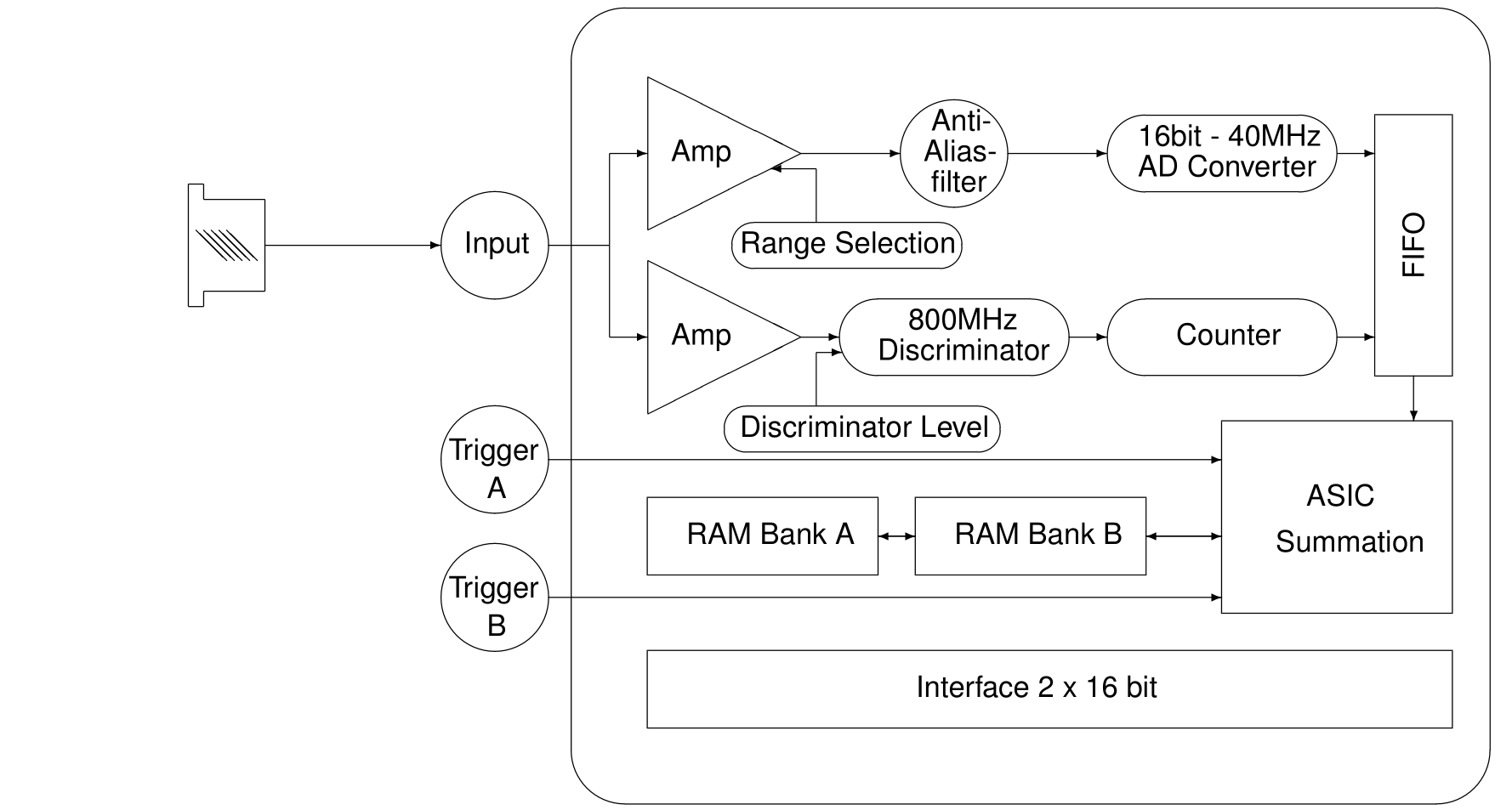
Analog detection of the photomultiplier current and single photon counting is combined in one acquisition system. The combination of a powerful A/D converter (16 Bit at 40/80 MHz) with a 800 MHz fast photon counting system increases the dynamic range of the acquired signal substantially compared to conventional systems. Signal averaging is performed by specially designed ASIC's which outperform any CISC- or RISC-processor based solution. A high speed data interface to the host computer allows readout of the acquired signal even between two laser shots. The implementation of this concept makes the Licel transient recorder the state of the art solution for all applications where fast and accurate detection of photomultiplier, photodiode or other electrical signals is required at high repetition rates.
Applications:
- LIDAR (Light Detection and Ranging)
- LIF (Laser induced fluorescence)
- TDLAS (Tunable Diode Laser Absorption Spectroscopy)
- and other pulsed optical signal techniques.
Principle of operation
The Licel transient recorder is comprised of a fast transient digitizer with on board signal averaging, a discriminator for single photon detection and a multichannel scaler combined with preamplifiers for both systems. For analog detection the signal is amplified according to the input range selected and digitized by a 16-Bit 40/80 MHz A/D converter. A hardware adder is used to write the the summed signal into a 32-Bit wide RAM. Depending on whether trigger A or B is used, the signal is added to RAM A or B, which allows acquisitions of two repetitive channels if these signals can be measured sequentially.
At the same time the signal part in the high frequency domain is amplified and a 800 MHz fast discriminator detects single photon events above the selected threshold voltage. 64 different discriminator levels and two different settings of the preamplifier can be selected by using the acquisition software supplied. The photon counting signal is written to a 32-Bit wide summation RAM which allows averaging of up to 65534 acquisition cycles.
Detection of light signals ranging over 5 orders of magnitude
In remote sensing applications like LIDAR (Light Detection and Ranging) a photomultiplier looking at a laser pulse sent out into the atmosphere is driven close to saturation by the backscattered light from the vicinity, but a few hundred microseconds later it is required to detect single photons returning from a distance of 40 to 80 km. This high dynamic range of up to five orders of magnitude is one of the challenges in the detection of LIDAR signals as well as in other techniques like LIF (Laser Induced Fluorescence) or CARS (Coherent Anti Raman Scattering).
Usually, the detection systems are optimized for measuring low level light intensities using the single photon counting technique but at higher light levels this approach results in nonlinear signal response.An analog measurement of the photomultiplier current is therefore necessary to increase the dynamic range.
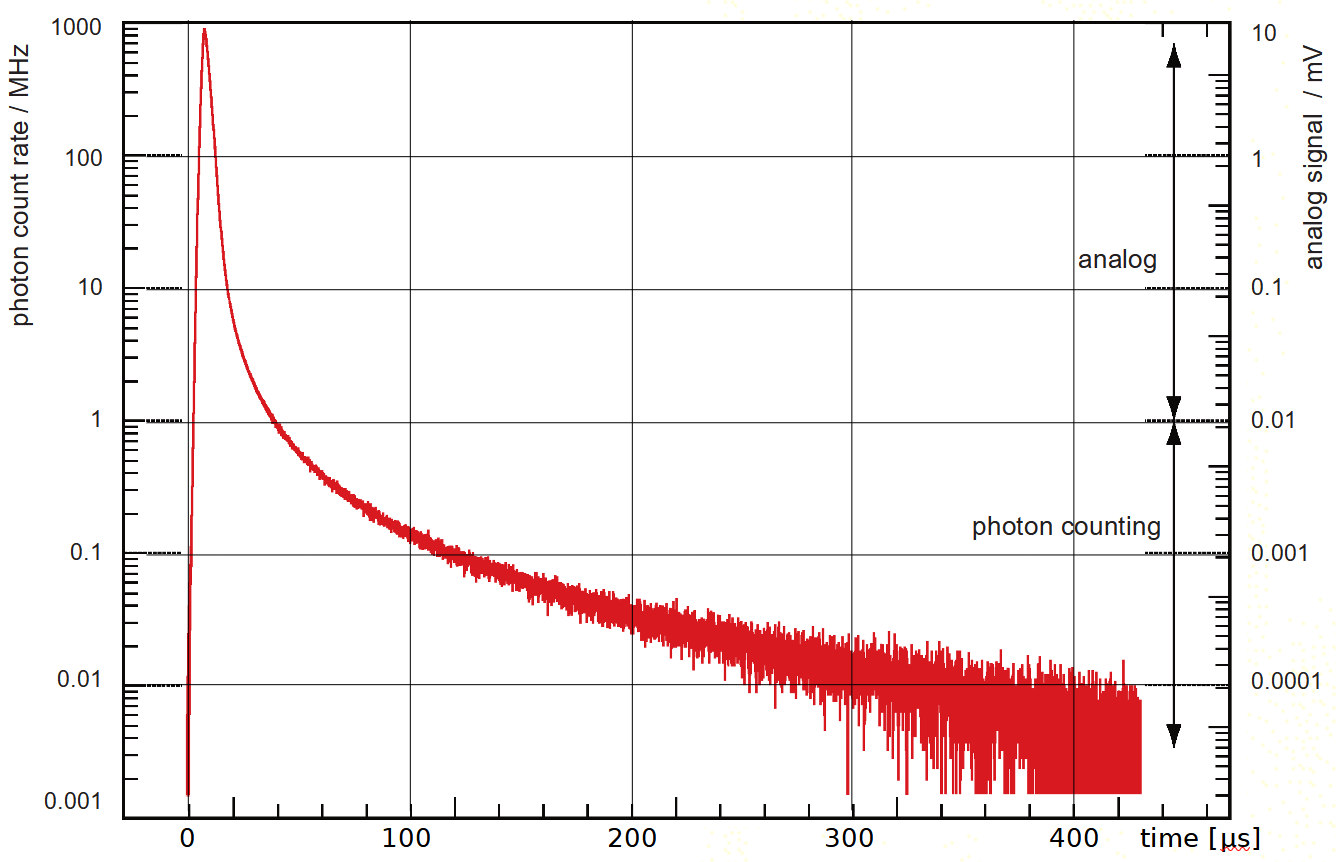
Combined analog and photon counting acquisition
Analog and photon counting detection techniques require different signal conditioning. A high speed and high gain amplification is needed for photon counting, whereas a strictly linear amplification below the Nyquist frequency of the A/D converter is necessary for analog measurement. Only the integration of two complete acquisition chains from the preamplifier to the summation memory will therefore enable you to combine both techniques for increased linear dynamic range. This has been done in the Licel transient recorder.
High end analog acquisition
The best 16-Bit A/D converter available at 40 MHz sampling frequency was used to build a high end transient digitizer with a signal to noise ratio greater than 74 / 72 dB up to the Nyquist frequency of 20 / 40 MHz. Carefully shielded preamplifiers for three different input ranges and a fast hardware adder can average up to 65534 shots of 800µs at 40 /80 MHz signals to attain a maximum resolution of 0.0001 µV (500 mV input range). Each sample is checked for overrange to control clipping in the average signal.
Fast Photon Counting
The photon counting acquisition system includes a fast preamplifier and a discriminator with 64 threshold levels, controlled by the host computer. With a maximum count rate of 800 MHz, single photon counting is pushed to new limits when the selected photomultipliers are used. A time resolution of 25 / 12.5 ns without any dead time or overlap between two memory bins is reached by using a continuous counter together with a multichannel scaler burnt into the silicon of a custom designed ASIC.
Complete acquisition software
The Licel transient recorder is completely software controlled. Input ranges for analog and photon counting acquisition, discriminator levels and the Number of active bins can be selected. The acquired analog and photon counting signals for both summation memories can be read out separately. Data is transferred via a 2 x 16 Bit interface to a Ethernet controller which is then connected to the PC.
The data transfer rates are 1800 KB/sec. Up to 16 Transient recorders can be controlled by one Ethernet controller. A ready to use LabView Interface comes with each Licel transient recorder. It can be run on PC/Windows platforms. C Software drivers and acquisition programs for PC/Linux are supplied.
Specifications
| In/Outputs: | |
| Signal input: | BNC, 50 Ohm, frontpanel |
| Trigger A: | BNC, 1kOhm, frontpanel |
| Trigger B: | BNC, 1kOhm, frontpanel |
| Racktrigger: | A, B |
| Optional Trigger: | C, D |
| Host I/O: | 50-pol bus., backpanel |
| Indicators: | -Analog input range |
| -Signal overrange | |
| -Trigger and Host I/O | |
| Environmental: | |
|---|---|
| Power: | 230V/50 Hz or 110V /60Hz, 5 W per transient recorder. |
| Operating temperature: | +10º to + 40º C |
| Storage Temperature: | -30º to + 70º C |
| Humidity: | 0 to 95%, non condensing. |
| Dimensions: | Each transient recorder is mounted in a RF-shielded cassette 50.4 x 128 x 232 mm. Systems up to 8 channels are mounted in a 448.6 x 375.5 x 177.8 mm housing for 19" rack mounting. |
| Analog acquisition: | |
| Signal input range: | 0... -20 , -100, -500 mV |
| A/D Resolution: | 16 Bit |
| Sampling rate: | 40 MSPS / 80 MSPS |
| Lidar spatial resolution: | 3.75 m / 1.875 m |
| Bandwidth: | DC-20 MHz / DC-40 MHz |
| A/D differential nonlinearity: | typ. 0.5 LSB |
| max. 3 LSB @25º C | |
| A/D integral nonlinearity: | typ. ±3 LSB @25º C |
| Spurious free dynamic range: | 88 dB /82dB | |
| S/N single shot: | 74 dB@100mV / 72 dB@100mVinput range (100mV) | |
| Memory depth: | typical: 16 384 bins, max. 32768 bins, | |
| Summation memory: | 2 channels | |
| 65534 acquisitions | ||
| Repetition Rate: | depending on memory length and sampling frequency | |
| Protection: | Diode clamped | |
| Input impedance: | 50 Ohm | |
| Coupling: | DC | |
| Trigger Delay and Jitter: | 50 ± 12.5 ns / 25 ± 6.25 ns | |
| Photon Counting Acquisition: | ||
|---|---|---|
| Max. count rate: | 800 MHz | |
| Threshold: | 0... -25 mV | |
| 0... -100 mV | ||
| Discriminator: | 64 levels for each input range, software controlled | |
| Lidar spatial resolution: | 3.75 m / 1.875 m | |
| Summation memory: | 2 channels | |
| 65534 acquisitions | ||
| Input impedance: | 50 Ohm | |
| Bandwidth: | 10 MHz - 600 MHz. | |
| no dead time or overlap between bins. | ||
| Trigger: | ||
| 2 Trigger inputs to acquire signals in 2 separate summation memories. | ||
| Impedance: | 1 kOhm | |
| Threshold and slope: | 2.5 V, positive, 50ns risetime | |
| Rack Mechanical Dimensions | ||
Back to index